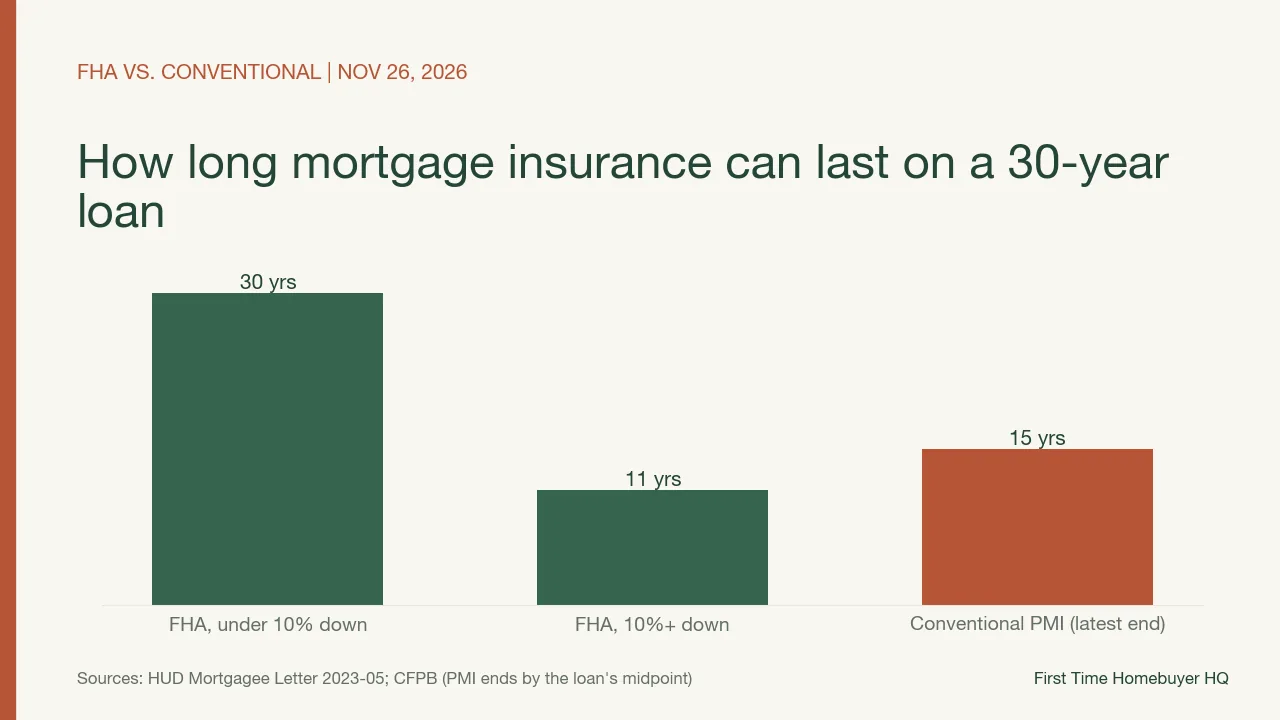
On an FHA loan, annual mortgage insurance lasts 11 years if you put at least 10% down and the life of the loan if you put down less. On a conventional loan, you can ask to cancel PMI at 80% of the home's original value, and it must end automatically at 78% or at the loan's midpoint.
Why do low-down-payment loans charge mortgage insurance?
Mortgage insurance protects the lender, not you, if a borrower stops paying. It is what lets many first-time buyers put down less than 20%. FHA loans require it on every loan, and conventional loans usually require private mortgage insurance, or PMI, when you put down less than 20%. The two follow different rules.
HUD says an FHA down payment can be as low as 3.5% of the purchase price. That small down payment is why FHA is common among first-time buyers, including Florida buyers pairing a first mortgage with down payment assistance. The tradeoff is the insurance cost, and with FHA it can stay on the loan for a long time.
How much does FHA mortgage insurance cost?
FHA charges two premiums. The upfront premium is 1.75% of the base loan amount and can be financed into the loan. On loans longer than 15 years with base amounts up to $726,200, the annual premium is 0.55% with less than 5% down and 0.50% with 5% or more, paid monthly.
Those rates come from HUD Mortgagee Letter 2023-05, which cut annual premiums for loans endorsed on or after March 20, 2023. HUD's list of mortgagee letters showed no later premium change when we checked on November 26, 2026. Larger loans and 15-year terms have different rates.
For scale, on a hypothetical $300,000 base loan, the upfront premium is $5,250. An annual rate of 0.55% on $300,000 is $1,650 a year, about $137.50 a month. Your Loan Estimate shows the actual monthly figure for your loan. The CFPB notes that FHA's premium costs the same regardless of credit score.
When does FHA mortgage insurance end?
Under HUD's current table, the annual premium lasts 11 years if your loan-to-value ratio at the start is 90% or less, meaning roughly 10% or more down. Above 90%, it lasts for the full mortgage term. With 3.5% down on a 30-year loan, that means paying it until the loan is paid off.
When can you remove PMI on a conventional loan?
According to the CFPB, you can ask your servicer in writing to cancel PMI once your balance is scheduled to reach 80% of the home's original value, or sooner if extra payments get you there. You generally need a good payment history, no second liens, and may need to show the value has not fallen.
Original value generally means the lower of the contract price or the appraised value when you bought. Extra principal payments can move the 80% date up, which is one reason some buyers choose a conventional loan even when the starting payment is similar.
Does PMI ever end automatically?
Yes. The CFPB says your servicer must end PMI automatically when your balance is scheduled to reach 78% of the original value, if you are current on payments. If that has not happened, PMI must end the month after the loan's midpoint, which is 15 years into a 30-year loan.
- 80% of original value: you may request cancellation in writing.
- 78% of original value on the original schedule: automatic termination if you are current.
- Midpoint of the loan term: final termination even if the balance has not reached 78%.
- If you are behind on payments, termination generally waits until the account is brought current.
How should a first-time buyer compare FHA and conventional?
Ask lenders to price both loans for the same home, down payment and term. Compare the monthly payment with mortgage insurance, the upfront premium, cash to close and how long the insurance could last. A lower payment today can cost more over time if the insurance never ends without a refinance.
Your credit score, down payment and debt load affect which loan prices better, and conventional PMI pricing varies by insurer and borrower. Side-by-side Loan Estimates are the clearest way to see the difference for your situation. Plan to keep the home for several years? Weigh the full-term FHA premium against the conventional cancellation dates.
Frequently asked questions
Can I cancel FHA mortgage insurance by asking my servicer?
Not under the current rules for loans with under 10% down. HUD's table sets the annual premium for the full mortgage term when the starting loan-to-value ratio is above 90%. With 10% or more down, it ends after 11 years.
Is the FHA upfront premium paid in cash at closing?
It can be, but it can also be financed into the loan. The CFPB notes the upfront premium can be rolled into the loan amount, which raises the balance you repay.
Is this article financial advice?
No. It is general education based on HUD and CFPB guidance checked on November 26, 2026. Your premiums and options depend on your loan, lender, credit and down payment, so rely on your own Loan Estimate.
Official sources
- U.S. Department of Housing and Urban Development: Mortgagee Letter 2023-05: Reduction of FHA Annual Mortgage Insurance Premium Rates (opens in a new tab) Checked
- U.S. Department of Housing and Urban Development: Mortgagee letters list (2024–2026) (opens in a new tab) Checked
- U.S. Department of Housing and Urban Development: FHA loans: down payment as low as 3.5% (opens in a new tab) Checked
- Consumer Financial Protection Bureau: When can I remove private mortgage insurance (PMI) from my loan? (opens in a new tab) Checked
- Consumer Financial Protection Bureau: What is mortgage insurance and how does it work? (opens in a new tab) Checked
Rates, deadlines, and rules can change after the checked date. Confirm current figures with the official source and your closing agent.