Yes, if you and the home both qualify. USDA's Section 502 Guaranteed Loan Program allows 100% financing for a primary residence in an eligible rural area, for households earning no more than 115% of the area median income. For fiscal 2027 it charges a 1% upfront guarantee fee and a 0.35% annual fee.
What is a USDA guaranteed home loan?
It is a mortgage from a private lender that USDA Rural Development backs with a 90% loan note guarantee. That guarantee is what lets approved lenders offer 100% financing, so qualified buyers can purchase with no down payment. The home must be your primary residence and sit in an area USDA defines as rural.
The official name is the Section 502 Guaranteed Loan Program. USDA describes it as helping low- and moderate-income households buy modest, safe homes in eligible rural areas. The loan can be used to buy a new or existing home, including attached homes, condos, PUDs, modular and manufactured homes, but not income-producing property.
For Florida buyers, rural does not always mean remote. USDA's map is set by its own definition, so it is worth checking specific addresses rather than assuming a town is in or out.
Who qualifies for a USDA loan in Florida?
USDA's program page lists three applicant requirements. Household income cannot exceed 115% of the area's median household income. You must agree to live in the home as your primary residence. And you must be a U.S. citizen, U.S. non-citizen national or qualified alien. Being a first-time buyer is not on that list.
Income is measured for the household, not just the people on the loan, and the limit varies by area. USDA's eligibility site has an income tool for estimating where your household stands. Your lender makes the final call using your documents.
How do you check if a Florida address is USDA-eligible?
Use USDA's Income and Property Eligibility site. Choose Single Family Housing Guaranteed, then the property eligibility link, and enter the address or browse the map. USDA says the site shows the likelihood of eligibility, so confirm the result with a USDA-approved lender before you write an offer that depends on it.
- Check each address you are serious about, not just the city name.
- Run the household income tool on the same site for your county.
- Ask your agent to note USDA financing in the offer if you plan to use it.
- Keep a screenshot of the eligibility result for your lender.
What does a USDA loan cost in fiscal 2027?
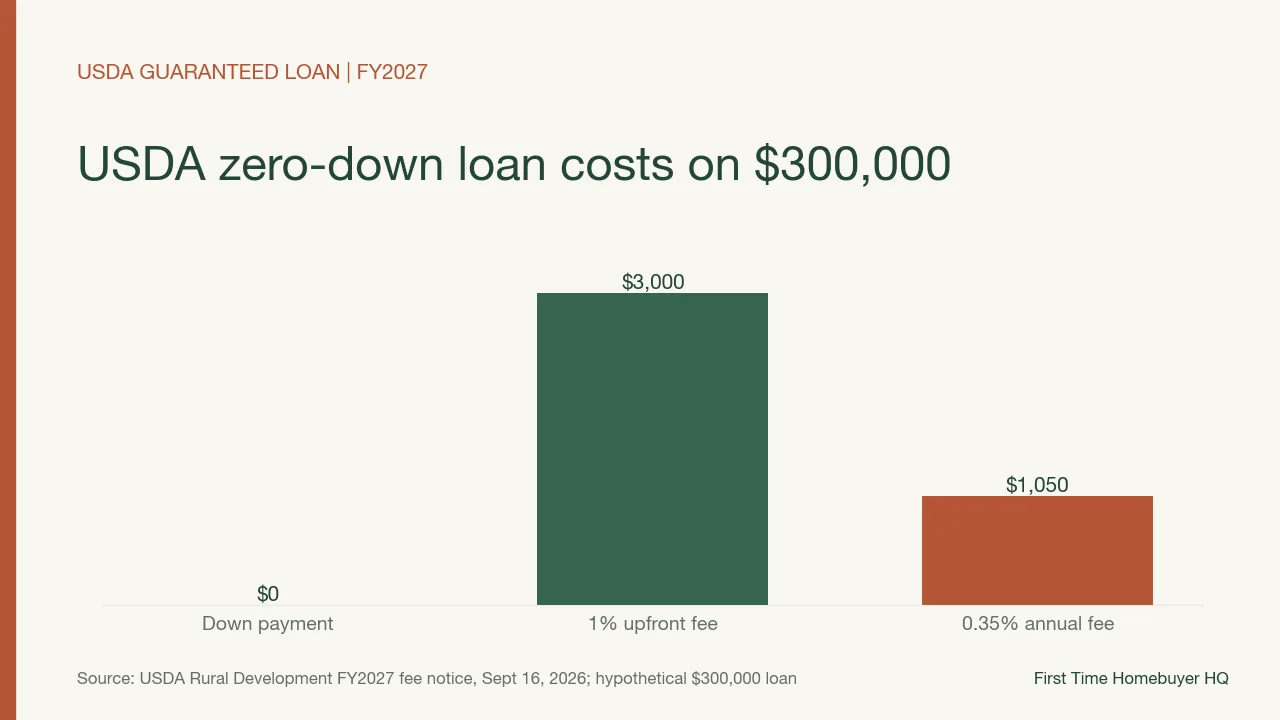
For fiscal 2027, which runs October 1, 2026 through September 30, 2027, USDA set a 1.00% upfront guarantee fee and a 0.35% annual fee for purchase and refinance loans. On a hypothetical $300,000 loan, the upfront fee is $3,000, and 0.35% of a $300,000 balance is $1,050.
USDA announced those fees in its Fiscal Year 2027 Conditional Commitment Notice to lenders on September 16, 2026. The same notice says the program typically runs short of funds for about a week at the start of each fiscal year, and loans can still close during that gap.
Interest rates are not set by USDA. The program page says lenders determine rates and encourages comparison shopping. To see how this fee structure stacks up against FHA mortgage insurance, ask lenders for Loan Estimates on both loans for the same home.
Can the seller pay closing costs on a USDA loan?
Yes, within a limit. Under a USDA final rule effective November 9, 2026, the seller or another interested party may contribute up to 6% of the sales price toward your closing costs, financing costs and escrows. Real estate commissions no longer count toward that 6% limit, which leaves more room for buyer help.
USDA's program page also says closing costs and reasonable, customary purchase expenses may be included in the transaction. Combined with seller help, that can bring cash to close down sharply, though you may still need money for items like the appraisal, inspection or an earnest money deposit before closing.
USDA rules also bar buyers from getting cash back at closing beyond their own out-of-pocket costs, so a seller credit larger than your actual costs does not turn into a check.
What credit score and loan terms does USDA require?
USDA's program page says there is no USDA credit score requirement, but applicants must show a willingness and ability to manage debt. Lenders can still apply their own standards, so ask each one what it requires. Guaranteed loans are 30-year fixed-rate only, and you apply through a USDA-approved lender, not through USDA.
USDA keeps a list of active approved lenders searchable by state and says it does not endorse any of them. If your income is too low for the guaranteed program to work, USDA points buyers to its Single Family Housing Direct programs, handled through state Rural Development offices.
Frequently asked questions
Do I have to be a first-time buyer to get a USDA loan?
No. USDA's guaranteed program page lists income, primary occupancy and citizenship or qualified-alien status as applicant requirements. First-time buyer status is not one of them, though you must live in the home.
Can I combine a USDA loan with seller-paid closing costs?
Yes. The seller or another interested party may contribute up to 6% of the sales price toward eligible costs, and since November 9, 2026, real estate commissions are excluded from that limit.
Is this article financial advice?
No. It is general education based on USDA Rural Development sources checked on November 27, 2026. Eligibility, fees and rates depend on your household, the property and the lender, so rely on your own Loan Estimate.
Official sources
- USDA Rural Development: Single Family Housing Guaranteed Loan Program (opens in a new tab) Checked
- USDA Rural Development: Fiscal Year 2027 Conditional Commitment Notice (fee structure) (opens in a new tab) Checked
- Federal Register / Rural Housing Service: Single Family Housing Guaranteed Loan Program-Limited Party Concessions (final rule, 91 FR 70769) (opens in a new tab) Checked
- U.S. Department of Agriculture: USDA Income and Property Eligibility Site (opens in a new tab) Checked
Rates, deadlines, and rules can change after the checked date. Confirm current figures with the official source and your closing agent.